
 Franchise Opportunities


Every serious conversation about housing affordability in Australia eventually arrives at tax. Capital gains tax concessions, negative gearing, stamp duty. It is the lever governments can pull quickly, and it makes for a clear announcement.
That lever has now been pulled. The Treasury Laws Amendment (Tax Reform No.1) Bill 2026 passed parliament on 25 June, and from 1 July 2027 negative gearing on residential investment property is limited to new builds, with the 50 per cent capital gains tax discount replaced by an inflation-based calculation for established property.
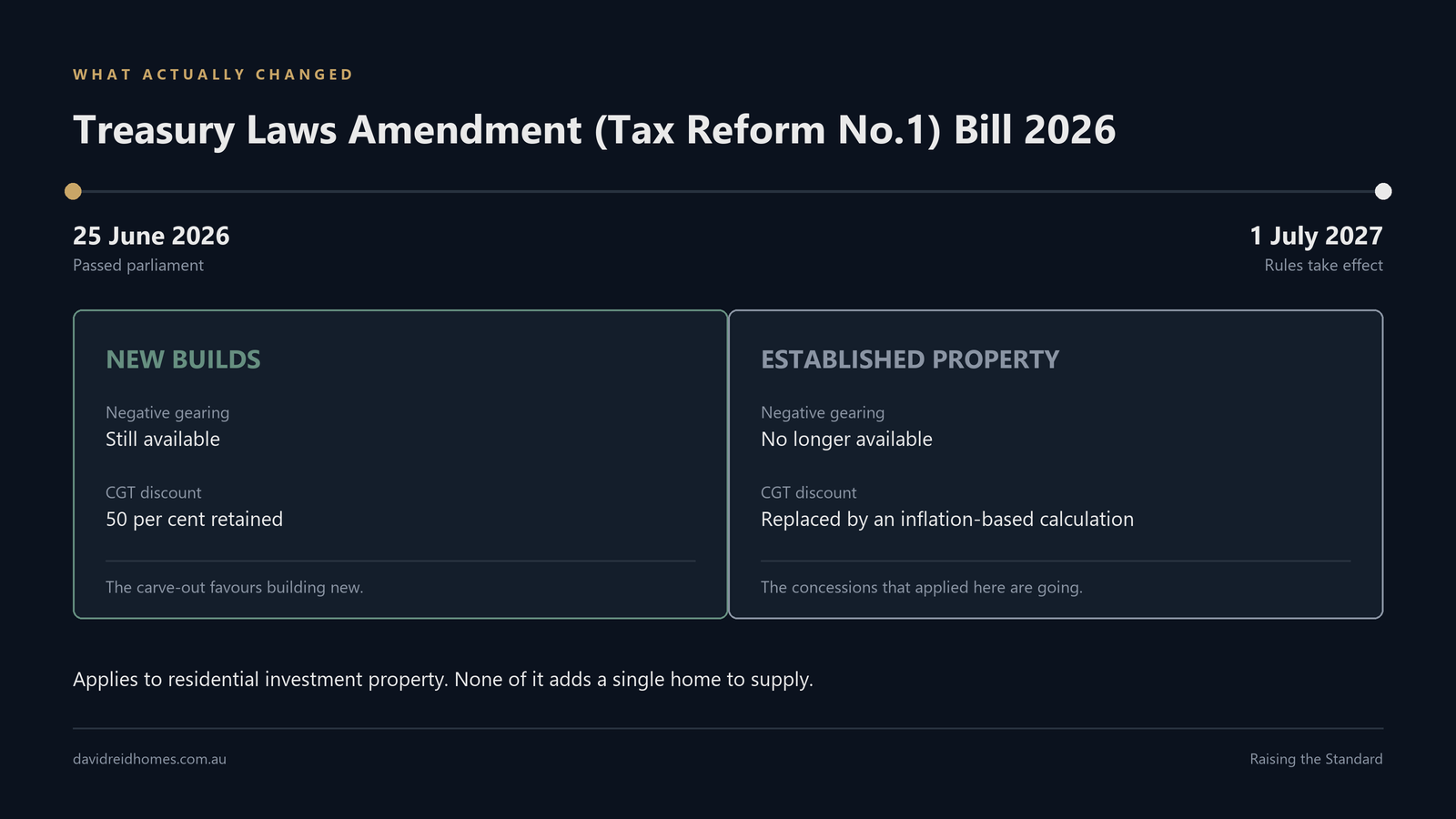
The problem is that none of it builds a house. Housing supply in Australia is constrained by land, approvals and cost, and the risk now is that a tax change gets mistaken for a supply solution while the actual bottleneck goes untouched.
Matt Jackson, Managing Director of David Reid Homes, has argued throughout the debate that tax settings alone will have little real impact unless all levels of government act together to unlock land, accelerate approvals and cut red tape and approval fees.
“You can tweak tax settings all you like, but if you don’t fix supply, you are not fixing the problem,” Jackson said.
“This is becoming a dangerous distraction from what actually needs to happen. Tax tweaks won’t build homes,” Jackson said.
Jackson said the focus on CGT risks oversimplifying a deeply structural issue.
“Housing supply is being strangled by slow approvals, limited land release and layers of red tape that add cost and delay at every stage,” he said.
“If governments genuinely want more homes built, they need to remove the barriers that are stopping builders from delivering them.”
He warned that without meaningful reform, any CGT-related incentives could fail to translate into actual housing outcomes.
“Incentives are useless if projects cannot get off the ground or stack up financially,” Jackson said. “You cannot stimulate supply if the system is working against it.”
A system that is choking new supply
Jackson said the current development and construction environment is pushing projects to the brink.
“Developers are dealing with prolonged planning timelines, inconsistent regulations across jurisdictions and escalating costs driven by high fees and compliance and process inefficiencies,” he said. “That is before a shovel even hits the ground.”
He said these pressures flow directly through to home prices.
“Every delay, every additional layer of bureaucracy and every inefficiency adds cost and those costs are ultimately borne by buyers,” Jackson said.
Federal, state and local government all hold a piece of it
Jackson said the solution requires coordinated action across all levels of government, not isolated policy changes.
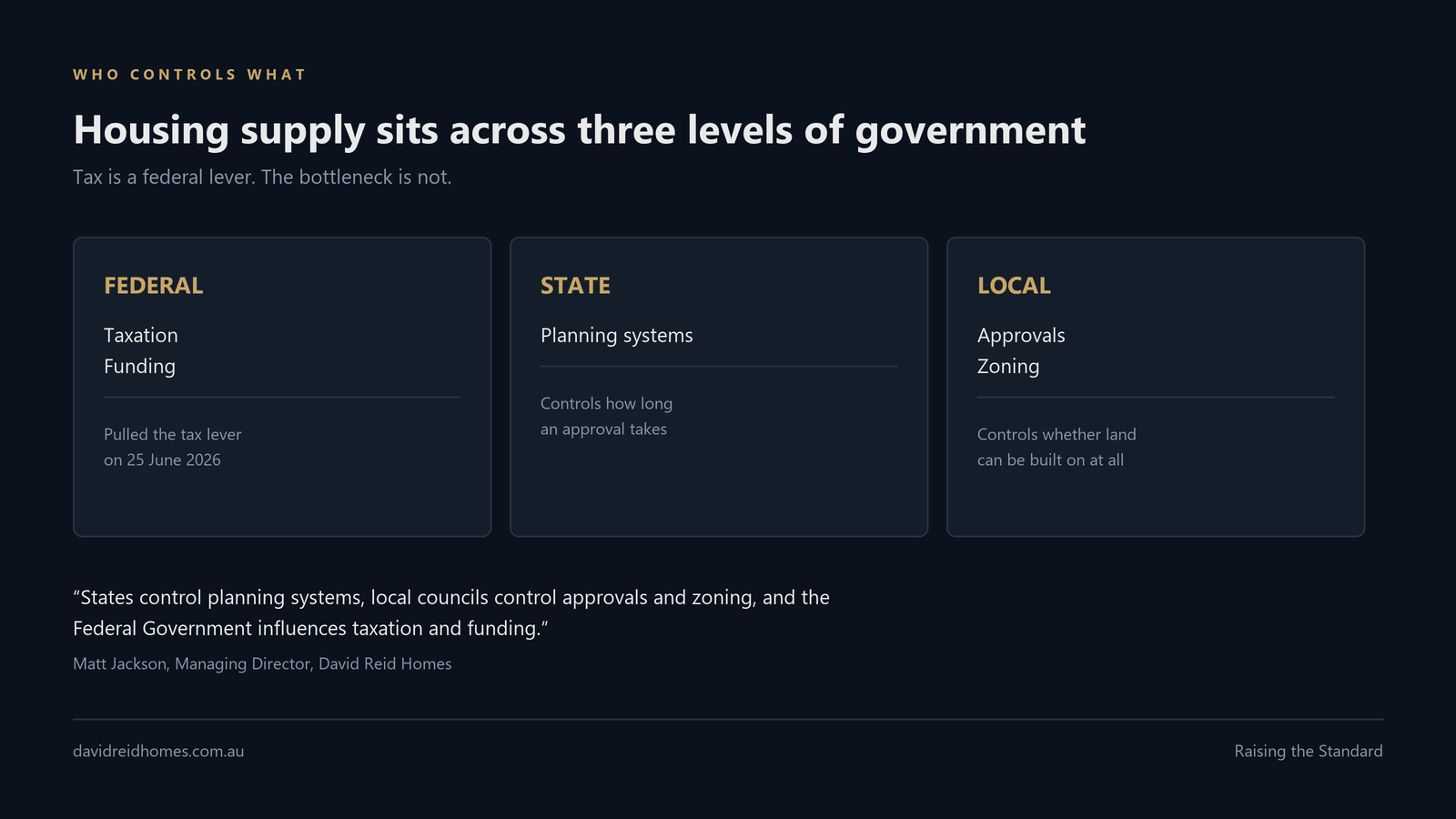
“This is not something the Federal Government can fix alone,” he said. “States control planning systems, local councils control approvals and zoning and the Federal Government influences taxation and funding.”
He said a fragmented approach is part of the problem.
“What we have now is a system where different levels of government are pulling in different directions,” Jackson said. “If they are serious about housing, they need to get aligned and act decisively.”
Release land, speed up approvals, cut the red tape
Jackson outlined what he believes are the most critical levers to unlock housing supply: significantly more land released for development, particularly in high-demand growth corridors; streamlined approval processes so projects are not sitting in limbo for months or years; and reduced red tape that adds cost without adding value.
“If you can get projects approved faster, reduce red tape costs and make construction processes more viable, you will see supply increase. This is how you move the needle, you stop the gouging.”
The risk of solving the wrong problem
Jackson said relying on CGT changes as a primary lever risks missing the bigger picture.
“There is a real risk that policymakers believe they are addressing housing affordability when, in reality, they are only addressing one small piece of a much larger puzzle,” he said. “If supply constraints remain, prices will continue to rise regardless of tax settings.”
He warned that failure to address structural barriers could have long-term consequences.
“If we do not increase supply in a meaningful way, we will continue to see affordability deteriorate, rental pressures intensify and home ownership move further out of reach for many Australians,” he said. “This is not a short-term issue, it is a generational challenge.”
He said the industry is ready to deliver, but needs the right conditions.
“Builders want to build, developers want to develop and investors want to invest. The question is whether the system will allow them to do it. Fix the system, not just the tax,” Jackson said.
What the change does do
None of this means the new settings are irrelevant to a homeowner. By pointing investor demand at new housing rather than established housing, they do change the shape of what gets built and who is competing for it. We have written separately about what the new rules mean if you are considering building as an investment.
Building in the current market
Approval timelines and site conditions are two of the biggest variables in any build program, which is why they are worth understanding before you commit to a block. Read more about building a custom home, or talk to your local David Reid Homes builder about what approvals actually look like in your council area.
This article is general information about market conditions and tax settings announced by government. It is not tax, financial or investment advice. Talk to your accountant or a licensed adviser about your own circumstances.